

Written and compiled by Dennis Bockus, PTM volunteer
Introduction
This is the chronicle of the Pennsylvania Trolley Museum’s progress of needs and acquiring the tools required for the above-mentioned subject. It is too long for a single document and hence will be issued in parts showing that PTM has developed significant tools which hopefully will result in more volunteers for machining/metal working. PTM definitely has the need for the work to be performed. In addition, a proper machining setup would make several repair jobs possible that might be unthinkable otherwise due to cost.
I must start out however by acknowledging that the writer is not a machinist but an Electrical Engineer that spent almost 40 years at the largest steel foundry in the US. We cast and machined steel castings from about 100 lbs. to 35 tons and a great many were machined in three large machine shops. The writer installed a number of machines and re-controlled almost 21 large machines. Railcar castings were a major product and passenger car/mass transit trucks were included and these required considerable machine work which was performed in house. I do know what machines can do.
PTM volunteer Artie Ellis, who retired from IBM Research, is a Tool & Model Maker. He has also spent 50 years around trolley museums and is quite familiar with their needs.
Machine work is cheaper, quicker, and with little transportation issues/cost if it can be done in house and if the machines are available. Outside machine shops want money, are disappearing fast, and PTM’s needs require larger machines that are not common in a “garage” or “basement” shop.
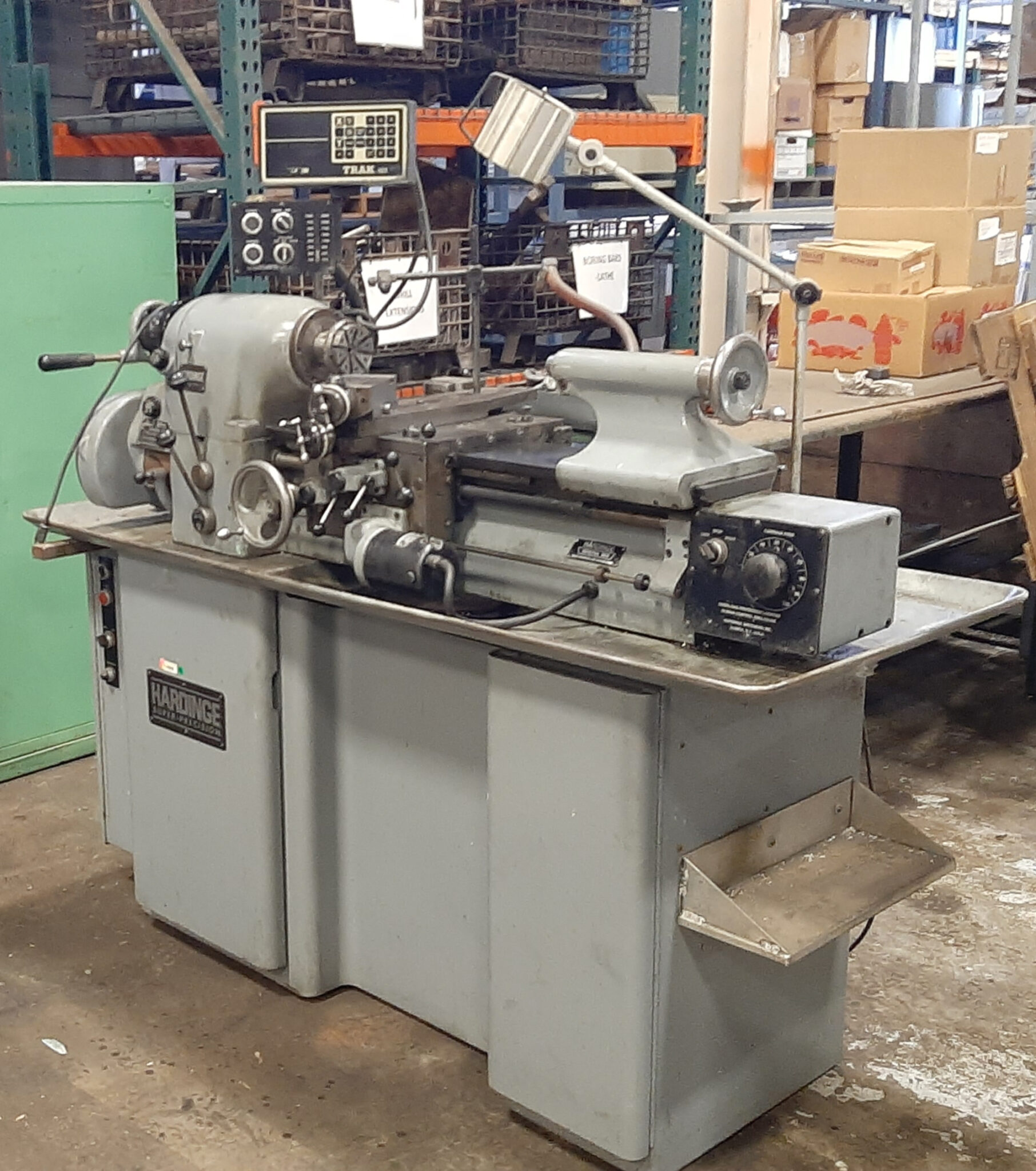
Hardinge lathe without chuck
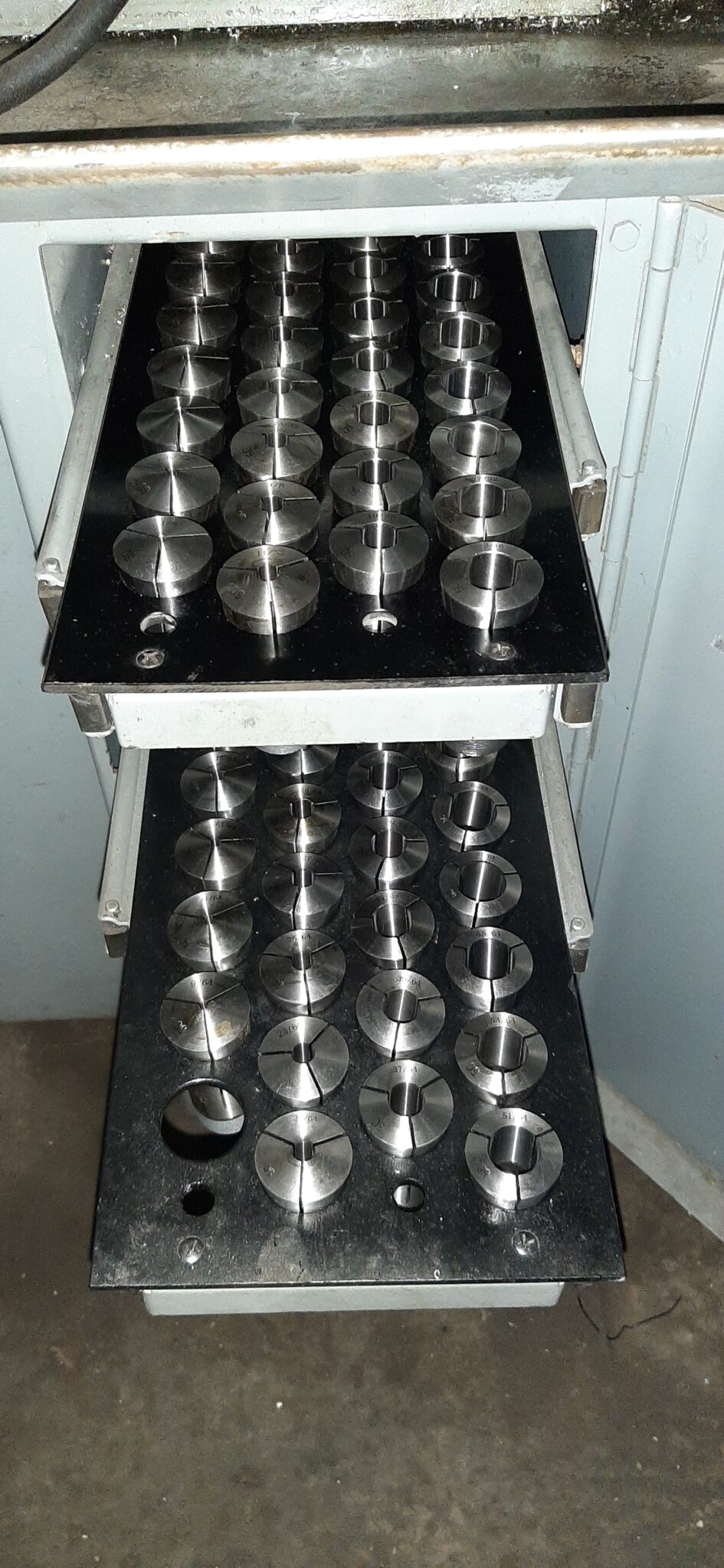
Collets stored in lathe base
Hardinge HVL-H lathe Precision Lathe
This small lathe was acquired from Federal Surplus in June 2021 for $1,500. It features a 1.5 hp drive, weighs 1700 lbs, and features continuous variable speed feed using the large knob on the right in the photo. It is the gold standard for machining small precision parts and is equipped with 2-axis digital read outs. The lathe came without collets and chuck, but Artie has obtained both, plus a dog and live center.
This lathe had only been lightly used and after a checkout PTM just had to install the needed 460-volt outlet so it could be plugged in. This same lathe, but not as nice condition, on Marketplace will sell for $9,000 to $10,000.
It has already been used to make a number of small parts. One project example was the air whistle/horn valves used on PTM’s operating cars. Even when the valve was “off” air was still leaking through as the valves were worn out with no remaining metal to seat tightly. The Hardinge lathe was used to create small but precision groves in the stems so O-rings could be applied thereby sealing the air leakage. Five valves have been altered for O-rings with excellent results. Besides being a nuisance, this reduces compressor operation somewhat and the extra wear on the compressor.
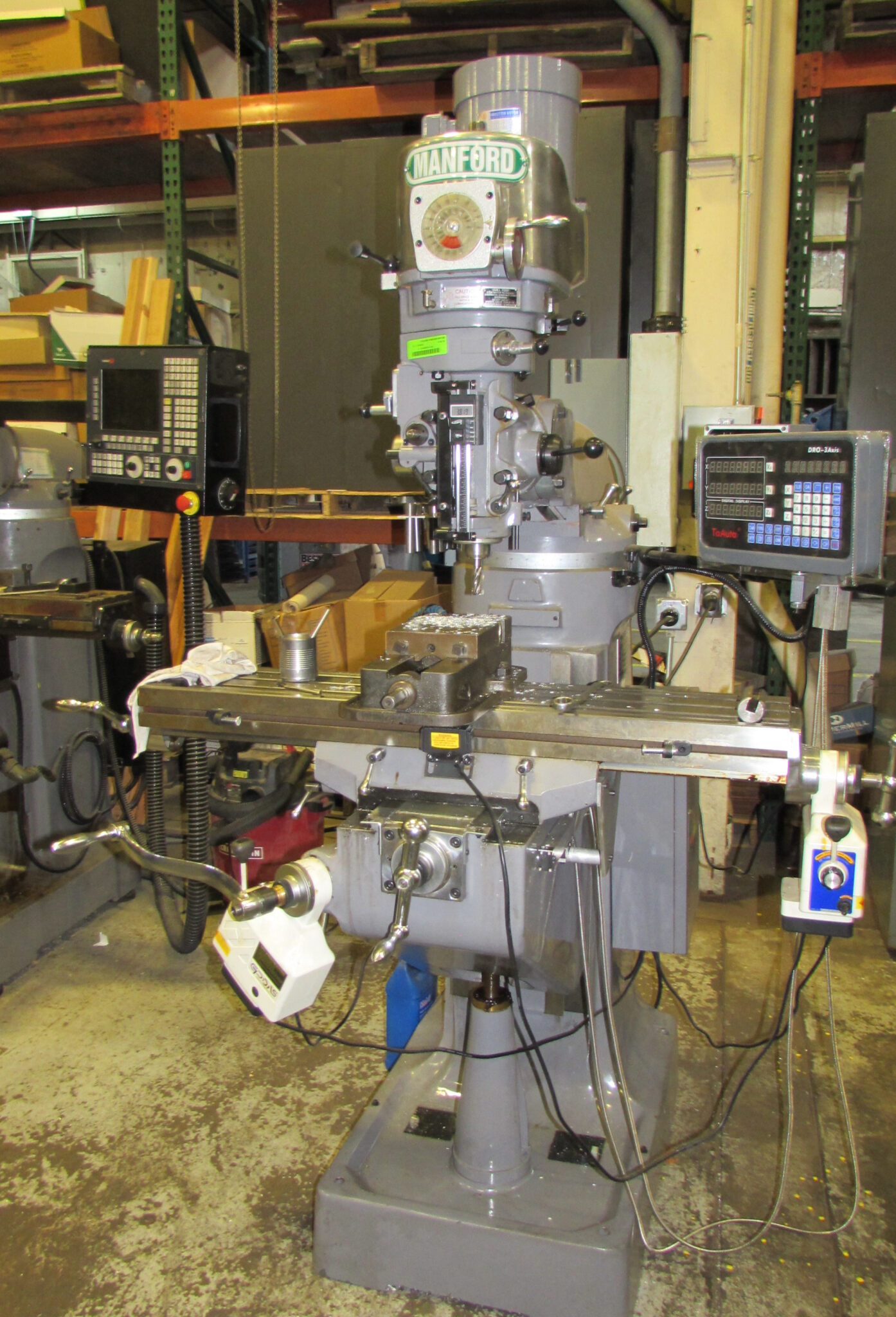
Manford with digital readouts
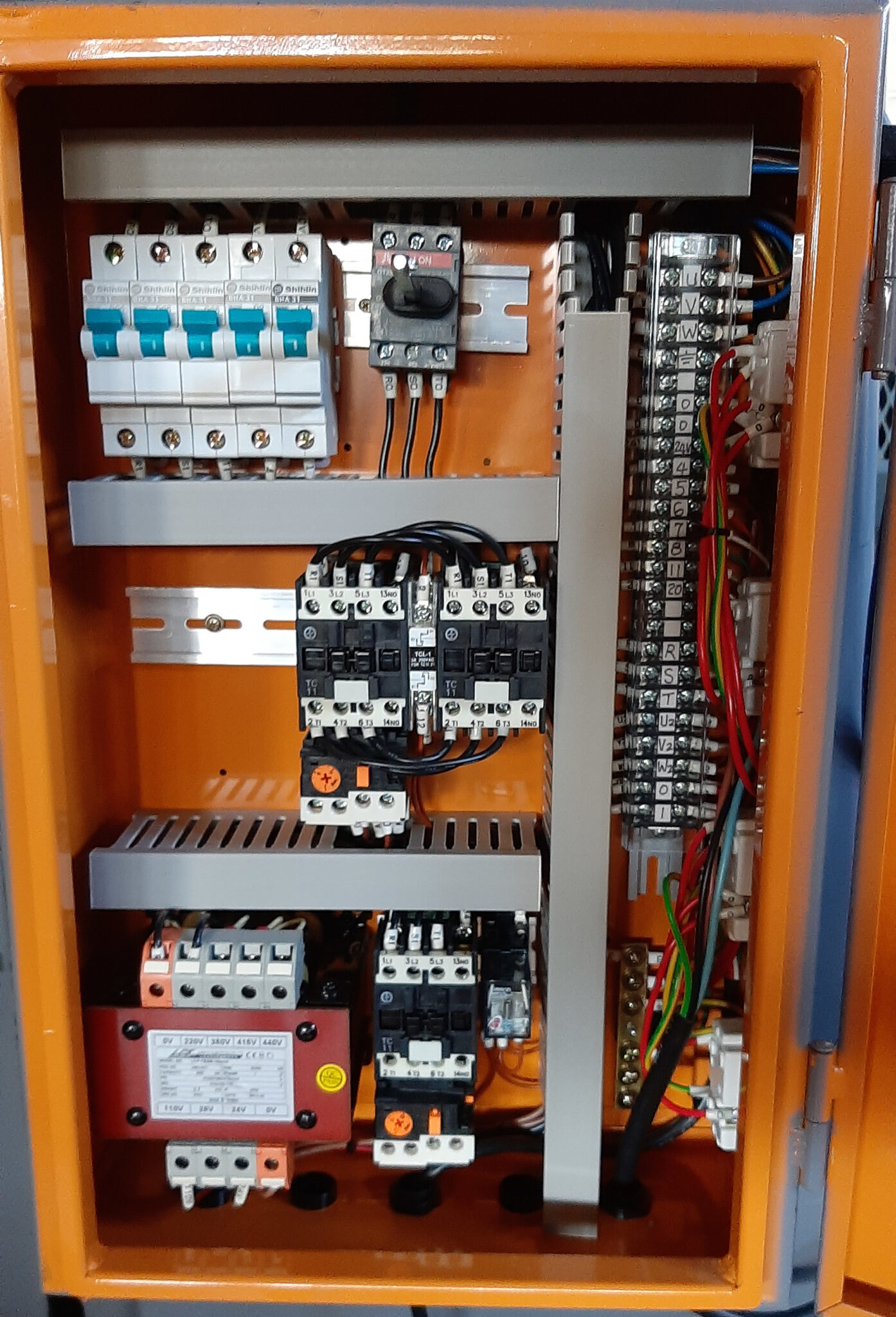
Manford electrical cabinet
MANFORD SP150VS VERTICAL MILL
This precision vertical knee mill was purchased from Federal Surplus in 2021 for $2,750. It was built in 2013, has a 9”x49” table, a 3 hp motor, was barely used, uses R8 collets, and weighs about 2200 lbs. It was very easily converted to 460-volt power. Also, a plug was needed and a suitable outlet. EBAY shows used units for $5,800 to $10,000.
Artie Ellis has since acquired an R8 collet set, added 2-axis digital readouts and two table power feeds. It is in use. At this point it is about 95% comparable to the Jet at the west shop which has a slightly larger active working area. This is an example of a desired parallel path. Current project is boring and sleeving five pneumatic door cylinders for PST 73’s restoration.
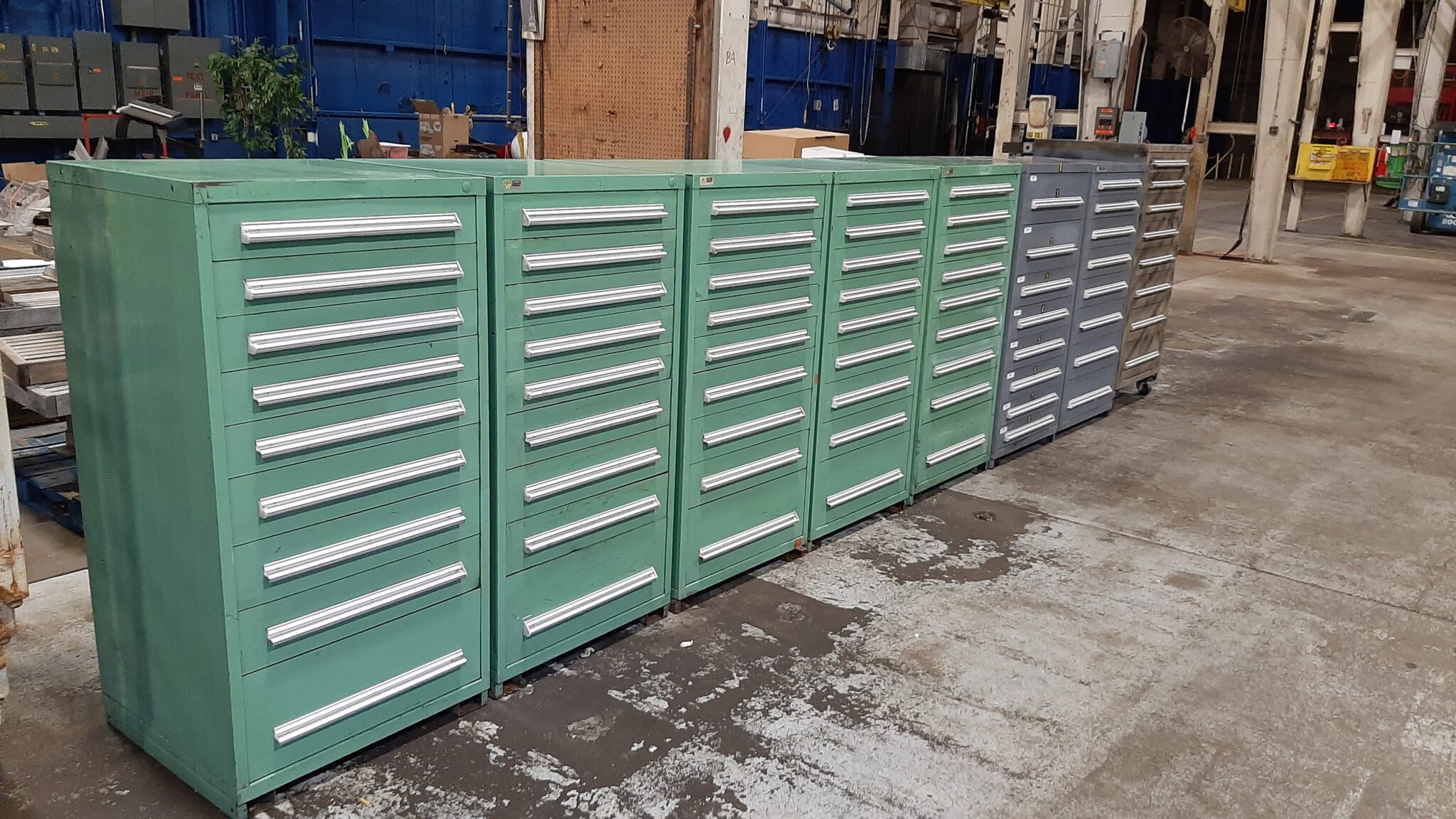
VIDMAR cabinets after cleaning
VIDMARS 1
As previously mentioned, PTM acquired from IPS a huge amount of tooling. First, all the large items were placed on pallet racks with a forklift. The smaller items are another story in that there are likely well over a thousand pieces. They come to us in numerous cardboard boxes, wood crates piled full of pieces, etc. They obviously needed to be sorted and organized so they can be used. But how to efficiently store them?
The de facto standard is VIDMAR cabinets. (There are several knock-off brands.) They are heavy duty and have drawers that are rated to handle 400 lbs. Tooling, which is mostly metal, is incredibly heavy. The problem is the costs are lethal. In 2021 a full height standard 9-drawer VIDMAR cabinet new cost about $2,300 while a good used unit around $1,000. No way could the budget handle this.
Then in December 2021 Federal Surplus in Harrisburg listed nine VIDMARS at $65 each. PTM sprung into action and grabbed all nine. This was also the time of the Manford mill coming home from Surplus, so the mill shared a rented box truck with the cabinets.
They were a little dirty but a Washington County Corrections inmate crew made quick work of cleaning them up. Three of the units went to PTM Facilities as they desperately needed some heavy-duty storage. Some sorting began and the cabinets are only mostly filled as other machining manpower requirements have taken priority. It is obvious to the writer that six cabinets will likely not be enough capacity for all the tooling, but they are a great start.

Foote-Burt Drill Press
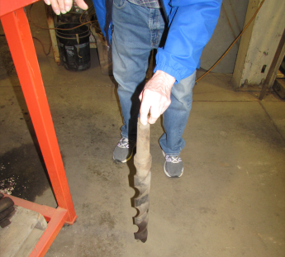
Sample Large Drill From IPS
Foote-Burt #25 drill press
This drill press was acquired in late 2021 for $500. It was located in the area and Kevin Zebley was able to pick it up with his trailer. It was built in the 1920s and was the Cadillac for its time as most other drill presses had open spinning gears in front of the operator. The owner had acquired it when he wanted two machines from a shop that had closed and had to buy the entire shop to get the machines he wanted. The previous shop had supposedly kept it in the back for when they needed to drill a really big hole. It uses #5 Morse Taper and is rated to drill as large a 3” inch holes (courtesy of IPS we actually have a 3” drill and smaller). Drilling holes less than 1” diameter is problematic as maximum speeds/feeds are set for much larger drills. The drill press does need some reassembly, a good cleaning, perhaps some grease seals, and some other items. We have on hand a suitable used combination 460-volt starter.
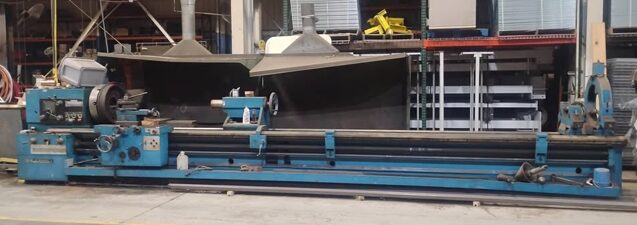
TOS SUS 80 lathe
LeBlond 36×132 lathe
As previously mentioned, in part 1 we acquired with the IPS machine purchase a TOS SUS 80 lathe. It had been purchased new by IPS in the late 1980s. It was a Czech-built lathe and could chuck up an almost 20’ long piece, way longer than the 10’ PTM would ever need. Upon hooking it up to 460-volt power it was found one of the screw base fuses was blown. Then it was found it was not European screw-based fuses but instead a Soviet bloc screw-based fuse, unobtanium in the US. All the screw-based fuses were replaced by C3Controls mini breakers, about $400. Lathe now runs and has been used for a few projects.
The main desire for this lathe was to turn wheels and PTM has a lot of that work pending. The problem was at best it could swing 33” diameter (some sources actually list it as 32”) and Red Arrow wheels as found are 35.5” over the flange. It might be possible to grind away parts of the lathe bed to make them fit, but the problems of tool post rigidity were questionable. Coupled with the Soviet bloc controls and the extra long bed (space) it was determined to try to find something better suited. Furthermore, the lathe was not located in a good location for PTM’s future plans for the building.
The LeBlond large heavy-duty 36×132 lathe was found on Marketplace in December 2022 was actually located about 4 miles from PTM at United Industrial and PTM had previously had them do some motor repair work. The previous United owner had purchased it for a project that never took place, and the new United owner wanted the space. The LeBlond successor company is still around and upon giving them the serial number, within 24 hours they come back with a pdf of the order which was placed 9-6-1941 and delivered on 5-21-1942 to a naval ordinance plant in Michigan. Those who know history will recognize the significance of the dates. It has a 20 hp motor, 4-jaw chuck, steady rest, and weighs in at an apparent 18,750 lbs. without the chuck or motor. Since it was for the trolley museum the owner donated it. He could also load it with his crane (as it turned out barely and he had to remove the tailstock to lighten it somewhat) and Brownlee Trucking donated the move. At Reliance, our two 10-ton cranes easily unloaded it.
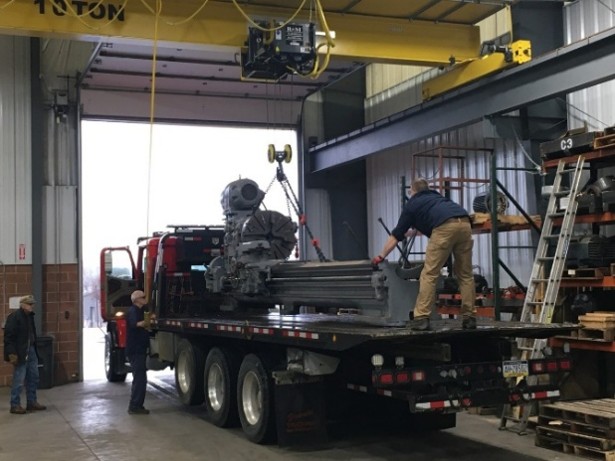
Lathe being loaded at United, tail stock removed

Sample large drill lathe at Reliance reassembled w/o driving dog
This lathe is not a wheel lathe but a lathe that can turn wheels. A wheel lathe is a purpose design with two tool posts so both wheels can be turned concurrently, and the gauge (standard) is fixed. These are now highly automated and to change to broad gauge, if possible, would take time and cost a lot of production loss. Our lathe can do one wheel at a time but to do the tread requires the addition of a tracer attachment. The good news is that the coming adjustment of the back-to-back distance on 73’s wheels and flange work can be done in the same manner as 66’s wheels on this lathe. We have been donated a Copy-Rite tracer unit, but its stroke is not long enough for wheel treads.
Since the lathe arrived, a used combination starter has been acquired and installed (lathe now runs) and Artie has replaced the brake/clutch linings. The lathe has been moved to its final location (inches), precision leveled with the help of Art Rizzino, and the tailstock has been reinstalled. Total PTM cost to install/make operational was about $2,500. In early 2026 Artie successfully reprofiled two axle sets of wheels for PST 73. Estimated cost to turn an axle set with volunteer labor is $30 each for power and inserts. Shipping the two axle sets to Lyons and the cost to do the work would be an estimated $2,500. The lathe installation is paid for.
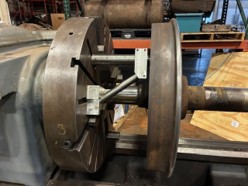
Artie designed and built SUPERDOG to turn wheel set
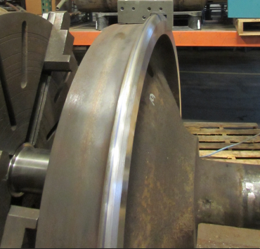
Completed wheel
PTM has a coming need in the next few years to reprofile the at least 20 axle sets of Red Arrow wheels, reprofile eight new wheels for Shaker 94 PCC, and actually turn flat spots out of two PCC wheels that came with the “Terrible Trolley”. The latter will definitely require a tracer attachment. PCC wheels are without axles thus requiring a different setup in the lathe which Artie has started.
Part 3 of this series will show up in a few weeks. Part 1 can be found here: https://pa-trolley.org/machine-chronicles-part-1/
The funds for the machine tools and their set up and/or installation have been donated by a small group of PTM members that support having the machining capability. Thus, no general fund raising or funds from another PTM budget have been used. Note the “Reliance Machine Tool fund” can handle any donations.
We need additional volunteers. Are you a retired machinist and want to keep making some chips? You do not have to be retired. Many CNC machinists find manual machining helps them learn. It’s a spoiler, but we do have one small CNC knee mill.
If interested contact Morgan volunteer@patrolley.org or 724-228-9256 X6014. She will take it from there. Stay tuned for Part 3!