
Written and compiled by Dennis Bockus, PTM volunteer
Introduction
This is the chronicle of the Pennsylvania Trolley Museum’s progress of needs and acquiring the tools required for the above-mentioned subject. It is too long for a single document and hence will be issued in parts showing that PTM has developed significant tools which hopefully will result in more volunteers for machining/metal working. PTM definitely has the need for the work to be performed. In addition, a proper machining setup would make several repair jobs possible that might be unthinkable otherwise due to cost.
I must start out however by acknowledging that the writer is not a machinist but an Electrical Engineer that spent almost 40 years at the largest steel foundry in the US. We cast and machined steel castings from about 100 lbs. to 35 tons and a great many were machined in three large machine shops. The writer installed a number of machines and re-controlled almost 21 large machines. Railcar castings were a major product and passenger car/mass transit trucks were included and these required considerable machine work which was performed in house. I do know what machines can do.
PTM volunteer Artie Ellis, who retired from IBM Research, is a Tool & Model Maker. He has also spent 50 years around trolley museums and is quite familiar with their needs.
Machine work is cheaper, quicker, and with little transportation issues/cost if it can be done in house and if the machines are available. Outside machine shops want money, are disappearing fast, and PTM’s needs require larger machines that are not common in a “garage” or “basement” shop.

Turnmaster Lathe

JET JTM-4VS Mill
Background
First, we will jump back to the year 2001. All car repair/restoration work took place in the Building #2 (Galbraith) shop. The east lean-to was the public visitor’s area, restrooms, store, and office. The west lean-to was used for parts storage and was crammed to the roof. The main shop area 160’ x 48’ with columns down the center contained three tracks; two tracks were east of the columns and were strictly dead storage of cars, and the track west of the columns was used for maintenance and restoration. The south end of this track was over a well-designed pit area for working on the underside of the cars and the trucks. The north end had car 4398, the middle PST 14 undergoing restoration, and the south position over the pit contained whatever car was having maintenance work performed.
A roughly 12’ space existed from the west track car sides to the west wall and contained the aisle that ran along the cars the length of the building. Also in this space was a parts washer, a light duty drill press, a small worn out (per Artie) Bridgeport mill, wood and metal bandsaws, a small work bench, wood working tools, large table saw, large planer, two jointers, a small South Bend 9 x 36 desktop ½ hp lathe, and a small welding area at the north end. The shop was uninsulated and the gas fired tube heater could raise the inside temperature 20+ ⁰F above the outside temperature such that on cold days shop work was difficult. Several volunteers used the meager machine tools, but some work had to be sent out due to size and machine type needed. The volunteer resident machinist at this time was Sam Bear.
The shop annex 64’ x 24’ addition on the north end of the shop was fully insulated and heated but overcrowded also. It contained the horizontal metal saw, the fireproof paint storage cabinet, a tiny office, a gloved sand blasting cabinet, and pallet racks that were stuffed with large parts such as motors, compressors, drum controllers, etc. Also, it was the garage for the PTM fork truck.
In summary, the west shop was too much in not enough space such that performing more than several tasks concurrently just was not possible. No space existed to add any metal working tools. In spite of this, good work was being accomplished.
Now let’s leap to the year 2015. Many improvements have taken place such as the building was insulated and metal sheathed, the existing heat now keeps it comfortable at 0 ⁰F outside, the two tracks on the east side are now one with a concrete floor, and a mezzanine at the north end of track 2 has been built. The South Bend lathe has been relocated under the mezzanine and joined by a Turnmaster 13 x 39 3 hp lathe (former Bureau of Engraving) purchased for $3000 via Federal Surplus, and a JET JTM-4VS 3 hp “knee” mill” with digital readouts. Both these machines are larger and have more capabilities than the Bridgeport and South Bend lathes and were kept quite busy. Many pins, bushings, sleeves and other items were created to upgrade our operating cars and make them more reliable (remember, most cars came to us worn out). All the compressors, controllers, traction motors in the annex along with some items stored in the shop itself had been relocated to the Artifact Preservation Building. This opened this space somewhat but a 70-ton H-press that came from Trolleyville was set up. The west side of track 1 was still quite congested but with the heat in the winter and the new machine tools, Bernie Orient’s crew accomplished considerably more work year over year. The resident volunteer machinist at this time was Ray Hatfield.
Machine work was still being sent out but as a sign of things to come in this era, the favored machine shop, Chiocca Machine in Bethel Park closed up shop. Other sources were found but they were more distant and not as convenient. Still there is absolutely no room at the west shop to add any machine tools.
Now let’s jump to 2026. The office, visitor center, and store all had moved to the east campus in summer 2024. Following the general concept from the 1990s, the south half of the east lean-to was converted into the wood shop plus the north half of the parts room is being set up for the larger wood working tools. The west side of track 1 has had almost all of the woodworking tools removed. Wood working has finally had its space decoupled from the balance of the main shop space. Tim Gump is the resident machinist. The point to be made is there still is no space available for more or larger machine tools.
Last, one must remember that larger machine tools require better material handling equipment as the work can get much larger and heavier. The west shop is not well suited for easy handling of heavy items.
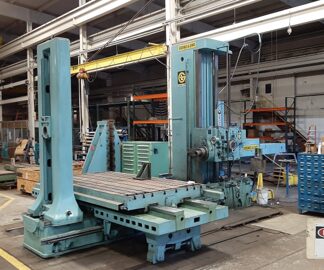
Gidding & Lewis #5 Horizontal Boring Mill Model 350T

Digital Readouts
The Reliance Building
In the fall of 2020 PTM was given 90 days’ notice that everything in the Eaton office building had to be removed and the building was to be demolished. This included the PTM archives and storage of many other items. PTM had zero capacity to store any of the items. First, leasing enough space turned out to be quite expensive and an endless drain on the budget. The Reliance Building had been up for sale for over a year but remember this was the time of COVID. Integrated Power Services leased the building from a Chicago based REIT whose other property in Pennsylvania was going to be sold shortly. They wanted to be done with Pennsylvania by the end of 2020. Furthermore, IPS was not going to renew its lease that expired in December. The REIT originally wanted just under $3,000,000 but having no other even warm prospects, settled for $2,550,000. PTM had no other debt so acquiring a 20-year mortgage was doable.
IPS, who had closed their motor shop in 2016, was storing critical large motors, gear boxes, etc. at sq. ft. rates (good money) and also subleased some space to Premier Automation. Except for the far west end of bay #3 (of 4), the building was full. The largest motor stored was 13,000 hp. Things were high or stacked high in most of the building with narrow walkways in many locations. In a few places it was like walking through a canyon with steep walls on either side and in other places like walking in a maze. My first trip through the building was short but the thought entered my mind this might someday be a good place for machine tools.
On my second trip to explore the “bones” of the building, I was walking west in bay #2 and I saw the “GIDDINGS & LEWIS” logo poking out above the stacks and worked my way over to it. It looked like a #5 Horizontal Boring Mill and G&L is the Cadillac of machines. Almost all the stuff stacked on and around the mill was tooling and huge quantities at that. I contacted Artie. “You must see this!” Artie arrived and the mill was examined closely. It had been very well taken care of but was quite dusty as it had been sitting for over four years. It looked like the mill was purchased new (1972) with every possible accessory including right angle head, facing head, rotary tables, etc. plus all the tooling that was there.
It was decided this was an opportunity PTM would never see again. Thus, IPS was approached “would they donate it”? No. It was already set to be in the auction to remove all their remaining equipment before the lease was up. When the dust settled, PTM ended up purchasing the mill and three other machines for $17,000 from IPS before the auction. The purchase included “all tooling for the four machines” and that would prove interesting later. No time to fundraise for the $17,000 so the hat was passed among members and about eight contributed and actually a little extra funds were included to recommission the machines. They had been electrically disconnected and drained of all oil (G&L alone was about 38 gallons).
So, what did we get for $17,000?

Milling custom angle bar

Newly drilled channel
#5 Giddings & Lewis Model 350T horizontal boring mill
This machine was purchased new in 1972 by Reliance Electric (precursor of IPS). It has a 60”x120” table, a power drawbar, 30 hp drive motor, 3-axis digital readouts, NMTB50 tooling, and about every accessory that was available. It had been well taken care of and perhaps was the queen machine so to speak. It also had all drawings, manuals, wiring diagrams, etc. Comparison shopping for the same mill found prices in the range of $29,000 to $35,000 (not a dealer’s price which would be much more) plus moving costs of at least $5000. Large machines such as this require a complex designed custom foundation with steel reinforcement. The writer installed a very similar foundation circa 1997 and the low bid by a contractor was $21,000. It likely would be considerably more now. Then there are precision erecting, leveling, and wiring. Last, I started adding up the accessories and tooling using Marketplace or eBay costs, not dealer costs. I easily cruised above $50,000 and quit.
What can this mill do that PTM might have need of?
- Re-machine truck pedestals (sometimes called jaws) which is the area a journal box rides in. The pedestal sides get worn and the journal boxes fit too loose and bang the pedestals which is bad for the journal bearings, gearing and motor support bearings. Typical fix is to build up the pedestals with weld and machine to correct dimensions. Sometime wear plates are involved.
- If a traction motor support (axle) bearing fails, the dowel pin might break and or the bearing or what is left of it will rotate damaging the bore in the motor steel casting and/or axle cap casting. The fix is again to weld repair and re-machine the bore. This is exactly what the G&L is designed for as it has the large out board tailstock support and the tooling from IPS provided us with about a dozen or more boring bars. I’ve seen this done on several DC traction motors at the foundry.
- Similar situation for the traction motor armature bearing supports with welding and line boring.
- Truck bolster centerplate bowls can get worn out of shape or a crack appears. Again, weld repair and re-machining.
- Need to bore and sleeve a trolley air compressor cylinder or face mill the block? This is the machine tool.
- Horizontal drilling of items that either the geometry and/or size prevents it from being drilled on a smaller machine. Drilling or milling a new dowel pin on a traction motor would be an example.
- Milling of items just too large for any other machine.
Then there is the tooling. As the G&L was almost buried with tooling and accessories, once we had possession of the machines and building, IPS had left us some stray pallet racks which were moved near the G&L and bolted to the floor. Many of the accessories and some tooling were removed from being stacked on the machine and placed on the pallet racks. Machine and the area around it were still full. Another pallet rack and later the VIDMARS helped. At this point it was realized the estimate made on amount of tooling was perhaps only 20% of actual. In addition, the IPS employees moving things out simplified the description to “all tooling” to PTM. It just kept coming and coming.
As fate would have it, the first machining project for the G&L was 24 individually customized track angle bars for Volunteer Blvd. Seems the girder rail special work consisted of tongues and mates of different heights/wear/cross section. Every angle bar had different heights on both ends, with offsets at the top and the bottom. All had a 9⁰ miter on the top and bottom and six 1.125” diameter holes. Twenty-four 1” plate burnouts were provided and they weighed almost 100 lbs. each. A tight fit was desired, but a number of angle bars had to come back for some added metal removal due to an imperfection in the web area of the rail and/or a temperature change. The work also had to be expedited due to the progress of Volunteer Blvd. We had tried to acquire a Cincinnati #4 mill for this work but that did not work out. Due to the expedited nature, one would estimate each bar would have cost $600 each or $14,400 from an outside shop. Note this work takes a fairly large machine.
The second project was drilling a number of holes in the flange of a 13” replacement steel channel for a Boston center dump car truck. Here, digital readouts saved considerable time. Once you knew the dimensions of the centers for the holes, the holes could be located using the digital readouts saving the time of laying out the holes out by hand.
A large amount of the tooling acquired can be used with machines that might arrive in the future. One will have to keep reading subsequent parts of this machine chronicle to find out.

Sample of Hundreds of Drills

Sample Of NMTB50 Tooling

Sample of Taps and Other Tooling
Marvel 8/M2/M8 vertical bandsaw
The second machine of the four purchased from IPS was a Marvel vertical metal band saw with power feed. The M2 indicates the extra height option, up to 23.5” while the M8 indicates it is a 12-speed model. The model number indicates this saw was new circa early 1970s. Doing some research shows EBAY prices in the $6000 to $9000 range plus shipping. The saw was hooked up and functional and just needed a good cleaning. It was however, located “way over there” in Bay #1. Still, it was used by PTM to perform a number of cuts. It is currently being relocated to Bay #2 near the other machine tools, an easy move and is just waiting for the electrical hook up.

Marvel Saw Before Relocation
Baldor 2 hp post grinder
This is a 2 hp industrial grade grinder with two 12” x 2” wheels and a cast pedestal for machine tool sharpening. It also has an attachment to make hand sharpening of drills easier. A new unit with wheels would have a list price of almost $5800 but they can be found discounted in the range of 25% off. Used grinders show up on Marketplace in the range of $1200 to $1600 plus freight or pickup. This grinder is in service.

Baldor Industrial Grinder
TOS SUS 80 lathe
This lathe will be discussed in part 2.
The Future
We have a start of much needed machine capacity and indeed the G&L might be the “mother” machine. To this end a list of desired machines and capacities was created and bounced back and forth several times between Artie and myself and, it has had some revisions.
The list contained the following concepts:
- The machines desired were classified into small (S), medium (M), and large (L). Fortunately, we have no external combustion (steam), Diesel locomotives, or passenger cars. These would force us into extra large (XL) and double extra large (XXL) or even huge (H) machines.
- In the small arena some parallel paths are needed as by far this is the highest volume of work.
- Machines were to be such that any work requiring Reliance machines could be completed there. No bounce back and forth to the west shop. All the machines at the west shop are small.
- Consideration must be given that if a machine is too small another machine may be too large for the task at hand.
- Thoughts were put into what work is forthcoming such as wheel re-profiling (lots), truck work including bearings of various types, making replica parts, rebuilding needs such as trolley bases, etc.
We are to the point where additional volunteers are needed. Are you a retired machinist and want to keep making some chips? You do not have to be retired. Many CNC machinists find manual machining helps them learn. It’s a spoiler but we do have one small CNC knee mill.
If interested contact Morgan volunteer@patrolley.org or 724-228-9256 X6014. She will take it from there. Stay tuned for Part 2!